by Jillaine Heather
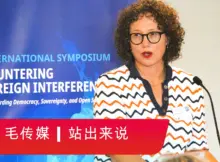
Key notspeech at the Countering Foreign Interference & Safeguarding Democracy, Sovereignty and Open Societies Symposium – 21 February 2026, Auckland
Good afternoon, everyone.
I’d like to extend a warm and heartfelt welcome to this international symposium focused on Countering Foreign Interference and Safeguarding Democracy, Sovereignty & Open Societies.
My name is Jillaine Heather. I am the Chief Executive of the Free Speech Union New Zealand, and the Free Speech Union is proud and honoured to be co- hosting alongside the Tasman Alliance of New Zealand.
I’d like to acknowledge the Tasman Alliance and “Lao Chen “/ Chen Weijian for organising this conference. It takes courage to build a pro-democracy organisation in any country. It takes particular courage when the regime you are standing up to has a very long reach.
I’d also like to welcome and thank all the speakers who have come from across New Zealand and overseas, and extend a warm welcome to our distinguished guests and speakers from Taiwan, and finally to extend a welcome and thank you to everyone here for showing up today to listen and participate.
Look around this room. You are not alone. Every person here has made a choice to be present, to stand up, to refuse to be silent. That is not a small thing. And the fact that we are here together, from different countries, different communities, different experiences, matters. Because the forces that want to silence us count on us feeling isolated, scared and divided. Today is proof that we are not.
Today you will hear from academics, politicians, journalists, experts, and fellow civil liberty advocates – who have all stood up for democratic freedoms.
But I am not here today as an academic or a policy expert. I am here because Portia Mao reached out to the Free Speech Union a few years ago – and her case is a powerful reminder of why freedom of speech – the ability to criticize, ask questions and disagree – is so important in a functioning democracy – and her case demonstrates how quickly that foundation can be attacked.
WHY FREE SPEECH IS THE FIRST TARGET
Foreign interference does not begin with spies or cyberattacks. It begins with silence.It begins with making speech expensive, risky, and exhausting – until people decide it is easier to say nothing.
Every authoritarian regime in history has understood this. The first thing they go after is not the army, the economy or the courts. It is the right to speak, it is communication. Because if you control what people can say, and the information they have access to, you don’t need to control much else.
That is why free speech is not just one freedom among many. It is the freedom that makes all the others possible.
Without it, you cannot organise.
You cannot protest.
You cannot hold power to account.
You cannot even name what is happening to you.
Every other right – democracy, rule of law, freedom of association – depends on the ability to speak.
Two weeks ago, two investigative journalists in China published an article on WeChat exposing local corruption. Three days later, both were arrested. The charge? “making false accusations” – essentially for writing a news article.
Then the article is deleted. Posts supporting the journalists were removed. And the message is clear: speak, and bear the personal cost. Only silence is tolerated
That is China in 2026. But as everyone in this room knows – some of those tactics are here as well.
PORTIA MAO’S STORY
Many of you know Portia Mao. She emigrated from China over two decades ago, became a journalist, and worked with the Stuff Circuit team on the documentary The Long Game, which exposed CCP interference in New Zealand. By putting her name in those credits, she put a target on her back.
Now what happened next should alarm every person in this room. A man she had investigated – Morgan Xiao, an aspiring politician and ardent CCP supporter – used the Harmful Digital Communications Act to obtain a court order barring Portia from criticising him. The application and court order was made without her knowledge.
The court sent one email – it bounced. Nobody tried again. Portia found out because Xiao was bragging about his victory on a Chinese-language chat forum.
Let me say that again. A journalist in New Zealand was gagged by a court order she never knew about, obtained by a man using a New Zealand law to silence scrutiny of his political activities.
Honestly, you could not make this up.
WHAT THE FSU DID
So, Portia reached out to the Free Speech Union for help. The FSU funded a barrister (her lawyer) to represent her.
In June last year, the judge ruled in Portia’s favour. He found her commentary did not amount to harmful digital communications. He found Morgan Xiao was – and I am quoting the court – “not a vulnerable person.” He warned against the weaponisation of legal tools to silence political criticism.
But Xiao was not finished. He tried the same thing against Justin Wong, a journalist for Stuff. Justin’s crime?
- He had reposted one of Portia’s articles on LinkedIn.
- He had also sent Xiao an email asking questions for a story.
The judge dismissed this case, and in her decision, she cited Portia’s case – the precedent the Free Speech Union helped set. The earlier victory directly protected the next journalist.
That is how this works. You fight for one person’s right to speak, and you slowly but surely build a wall that protects everyone who comes after.
And that is why gathering like this matters. Every case we win, every person who stands up, every room like this one – it makes the next act of courage, or defiance a little less lonely and a little less costly.
THE PATTERN
Now, these cases are part of a pattern – and many of you know it far better than I. Within the Chinese community in New Zealand, people who criticise the CCP get labelled “anti-China.” They are abused on Chinese-language social media.Their families back in China are contacted. They are surveilled. They are photographed at events like this one.
I want to be very clear: this should not be happening in New Zealand. New Zealand is not part of China. The political standards of the Chinese Communist Party have no authority here. Every person in this country has the right to criticise any government, any party, and any leader.
That is not a privilege. It is the baseline of a functioning democracy.
The NZ Security Intelligence Service’s 2025 threat report named the People’s Republic of China as the most active state conducting foreign interference in New Zealand. The Director-General said the public would often notice threats before the intelligence services did. – He was talking about you.
And it is not just Chinese born individuals. Three weeks ago, the Chinese Embassy in Wellington publicly condemned the New Zealand Herald for publishing an opinion piece about Taiwan – written by Jonathan Ayling.
A foreign embassy – telling a New Zealand newspaper what it is and is not allowed to print. We issued a media release emphasizing that our media exists to serve a New Zealand audience, not to reflect the sensitivities of overseas states.
WHY THE FSU MATTERS – WHO WE ARE
I want to speak directly about why the Free Speech Union’s work matters so deeply – particularly for diaspora and minority communities.
Portia’s case was not just about one journalist. It was about whether the Chinese community in New Zealand would be allowed to have independent voices, an independent press, and independent thought.
The outcome of the judge’s ruling matters beyond the courtroom. It helps shape how members of the community understand and choose between different values.
It says: in New Zealand, you are free to speak and free to criticise. And if someone tries to silence you, there are people who will stand with you.
Free speech is not a luxury for the comfortable majority nor just a privilege of the powerful (as we so often hear these days). It is the enabling right – the foundational right that makes all other rights usable. And the people who need it most are often the minority cowant to speak directly about why the Free Speech Union’s work matters so deeply – particularly for diaspora and minority communities.
Portia’s case was not just about one journalist. It was about whether the Chinese community in New Zealand would be allowed to have independent voices, an independent press, and independent thought.
The outcome of the judge’s ruling matters beyond the courtroom. It helps shape how members of the community understand and choose between different values.
It says: in New Zealand, you are free to speak and free to criticise. And if someone tries to silence you, there are people who will stand with you.
Free speech is not a luxury for the comfortable majority nor just a privilege of the powerful (as we so often hear these days). It is the enabling right – the foundational right that makes all other rights usable. And the people who need it most are often the minority communities with the least institutional support.
For those who do not know us – the Free Speech Union exists to defend the right to speak, to think, and to question, freedom of speech, conscience and intellectual inquiry
- mmunities with the least institutional support.
For those who do not know us – the Free Speech Union exists to defend the right to speak, to think, and to question, freedom of speech, conscience and intellectual inquiry
- We are a registered trade union, which means that we can represent members in workplace freedom of speech disputes.
- We are non-partisan. We don’t care where you sit politically.
- We care whether you can speak.
We have written over 120 letters to ministers, regulators, and institutions. We have filed more than 100 submissions. We have supported people who have lost their jobs, faced disciplinary action, or been dragged through the courts for saying what they believe. And it has worked.
We funded Portia’s legal defence and won, setting a precedent that protected the next journalist targeted by the same complainant.
- We backed a 15-year-old student excluded from his school speech finals for the content of his speech, and the school apologised and invited us in to deliver free speech training.
- We exposed unlawful police training that treated ordinary opinions as hate incidents
- We fought hate speech laws and won.
- We advocated for academic freedom legislation, and the Select Committee adopted most of our recommendations.
These are not abstract wins,
They are people who kept their voices, their jobs, and their dignity.
If you are facing pressure for speaking out – legal threats, workplace consequences, community intimidation – contact us. Become a member, we are a grass roots donor funded organization, support us, refer cases to us.
Every case we are able to take on makes the next person’s voice a little easier.
CHANGING THE LAW
And the good news is that the legal landscape is shifting – and the FSU has been part of making that happen.
The Harmful Digital Communications Act was meant to protect vulnerable people from online bullying. Portia’s case proved it can be weaponised to silence political speech.
In December, Melissa Lee, a Member of Parliament, lodged an amendment bill, developed in close consultation with the FSU, to fix exactly that:
- stronger protection for political commentary,
- a public interest defence, and
- no more gagging people who do not even know they are in court.
And in November last year, Parliament passed the Crimes (Countering Foreign Interference) Amendment Act, creating new offences for covert, deceptive, or coercive actions on behalf of a foreign state. You will hear more about this from the speakers directly involved.
These changes signal something important: New Zealand is beginning to take foreign interference seriously, not just as an intelligence problem, but as a threat to democracy (whicThese changes signal something important: New Zealand is beginning to take foreign interference seriously, not just as an intelligence problem, but as a threat to democracy (which is fragile and needs protection), and as a threat to the rights of people in communities like yours.h is fragile and needs protection), and as a threat to the rights of people in communities like yours.
REMOVING THE FEAR
I want to close with something simple. This conference exists because people refused to be silent.
Portia published her journalism because the public had a right to know. She was gagged. She fought back. She won. She is still here.
Justin Wong asked questions for a story. He was taken to court. The case was thrown out. He is still reporting.
Every person in this room who has chosen to speak – despite the risk, despite the cost, despite the pressure – is doing something profoundly important.
Because free speech does not survive on its own. It survives because people insist on using it.
Foreign interference depends on silence. It depends on fear. Every time someone in this room speaks, that silence cracks a little more.
And every time we gather like this – across borders, across communities, across languages – we prove something the authoritarians do not want proved: that the people who believe in freedom outnumber the people who fear it.
You are not alone in this fight. The person sitting next to you is not alone. And neither are we.
Free speech is not given to us by governments. Free speech is the natural condition of a free people. It is what happens when fear is removed.
Our job – the Free Speech Union’s job, your job, all of our jobs – are to speak up individually and collectively to remove the fear.
Thank you.
Jillaine Heather
Chief Executive Officer
Free Speech Union (New Zealand) Incorporated