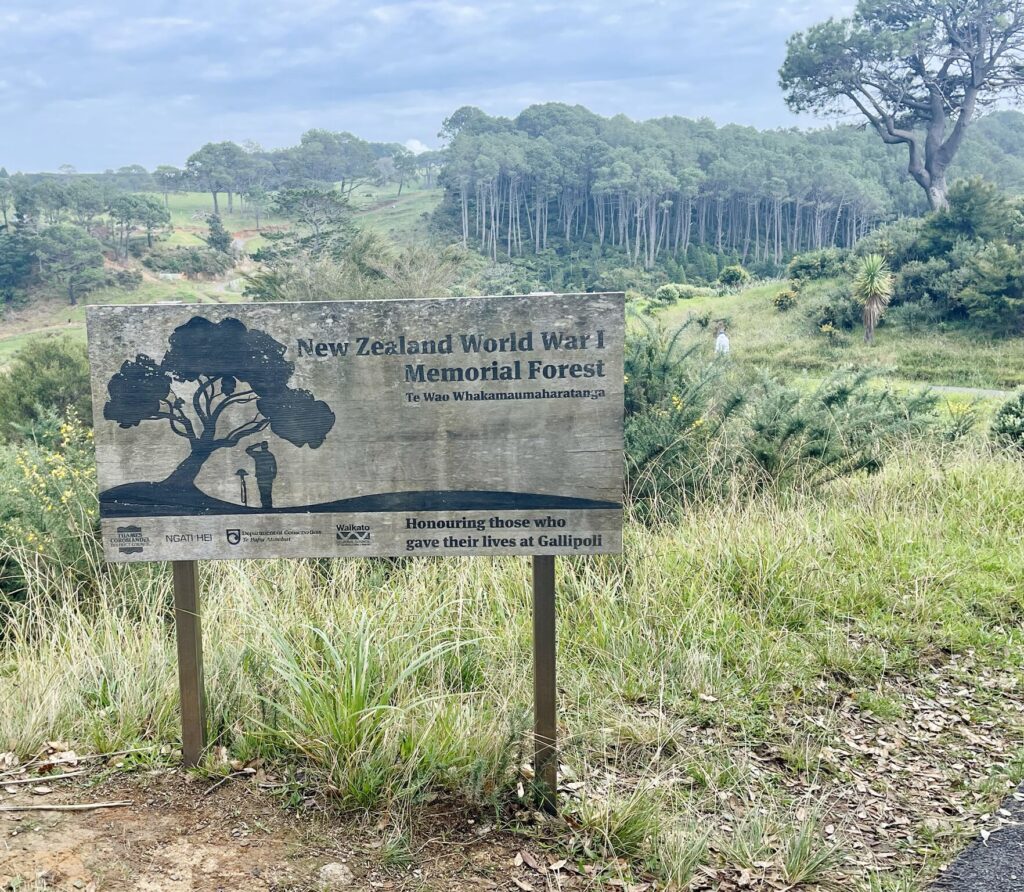
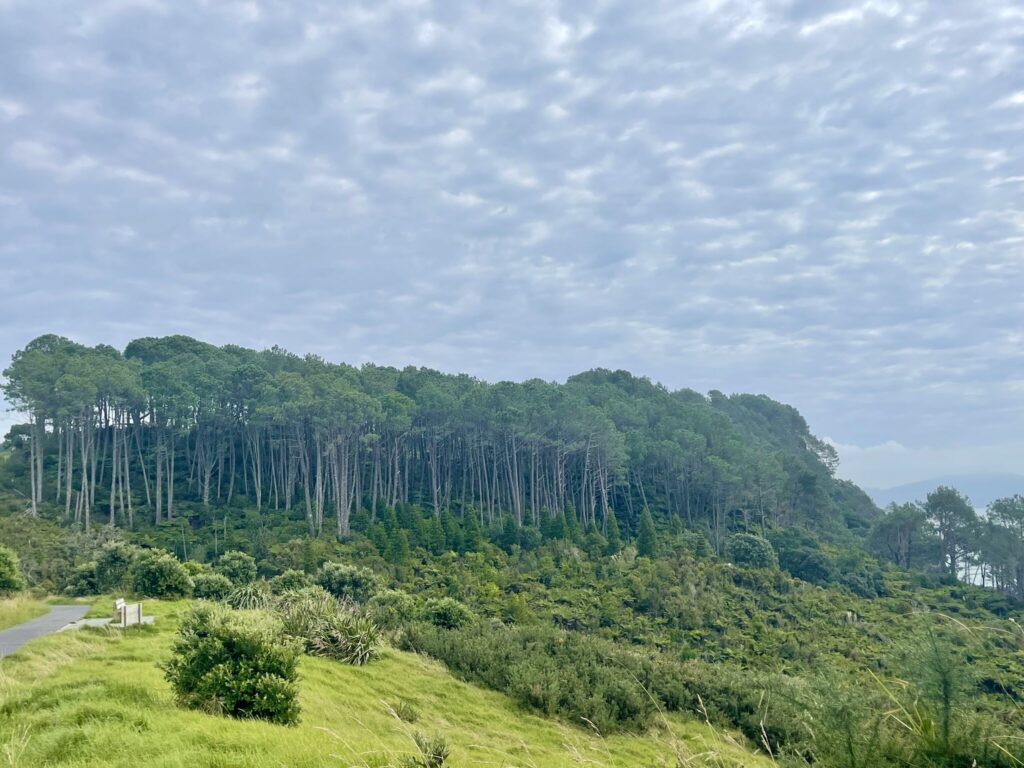
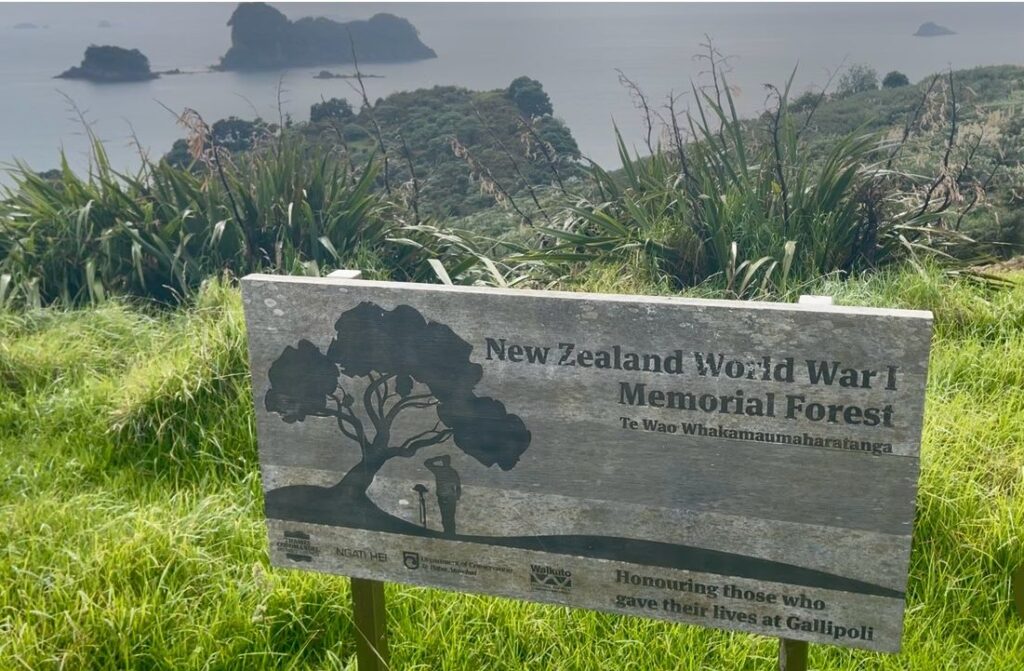
I hadn’t expected to come across two signs marking the New Zealand World War I Memorial Forest on my way to Cathedral Cove in the Coromandel Peninsula.
The forest, dedicated to the ANZAC soldiers, together with the surrounding beautiful and peaceful landscape, touched me deeply.
War remembrance matters. It reminds us not to forget those who sacrificed their lives amid the suffering and horrors of the battlefield. It also offers a moment to awaken strength, courage, and an unbreakable will.
The human spirit needs an element of steel and resolve—especially in today’s world, where peace, freedom, and democracy face mounting challenges.
奥克兰 BP New Lynn 加油站的 Ultimate 98 号汽油价格略高于每升 4 新西兰元。(图片来源:NZMEBP)
–
Z Energy 已在其网站和应用程序上发布更新,称 Sharetank 充值服务目前暂停。
Sharetank 允许 Z Energy 用户以更低的价格预购汽油或柴油,并以电子方式存储,直到需要加油为止。无论加油站的油价如何,都可以随时使用 Sharetank 充值,并且最多可以与五位其他 Z Energy 用户共享。司机每次最多可以购买 1000 升汽油,只需在 30 公里范围内找到最优惠的价格即可。
Free Speech: The Foundation That Makes All Other Freedoms Possible.
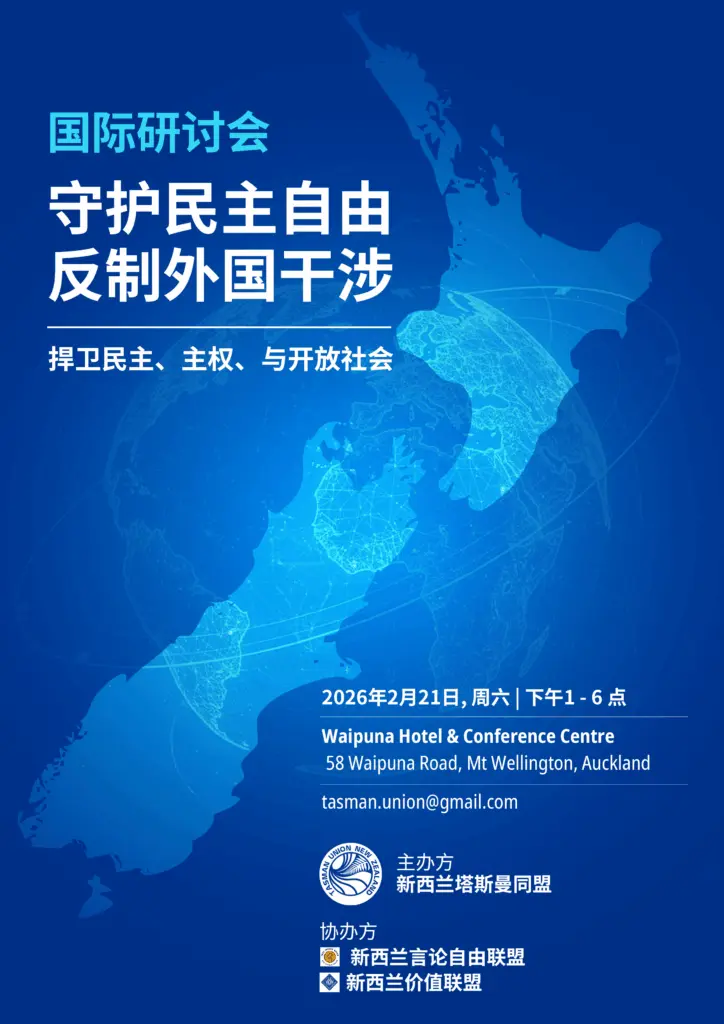
新西兰主要演讲嘉宾
安妮-玛丽·布雷迪(Anne-Marie Brady)教授 著名中国问题研究专家, 坎特伯雷大学 演讲题目:《民主“法宝”与中共“法宝”战略:对新西兰应对中国统战工作的反思》 The ‘Magic Weapons’ of Democracy and the CCP’s ‘Magic Weapon’ Strategy: Reflecting on New Zealand’s Response to China’s United Front Work.
Nick Hanne 先生: PILLAR NZ(捍卫个人生命、自由与权利)联合创始人 演讲题目:《 一部切实有效的法律: 透明与问责》 A Law Fit For Purpose: Transparency and Accountability
Paula Penfold 女士 Stuff 调查记者 演讲题目:《追踪线索:关于影响力与外国干涉的调查报道》 Following the Threads: Reporting on Influence and Interference
Simon O’Connor 新西兰前国会议员、前外交、国防与贸易委员会主席、对华政策跨国议会联盟(IPAC)校友理事会理事 演讲题目:《信仰自由》 / Free to Believe
Helen White MP 工党 Mt Albert 选区国会议员 演讲题目:《民主面临的威胁——对妇女与儿童的影响》
In my column on 29 January, Taiwan and China: Speech is the front line, I concluded: “We must recover the ability to say what is true, even if it carries consequences. Democracy is better than dictatorship. Freedom is better than oppression. Taiwan does not belong to China.”
In response, the Chinese Embassy issued an official statement and contacted my editor, calling on The Herald to act as a “responsible media outlet”, rather than “mislead the public or do harm to others without benefitting itself”. It added: “This is not a matter of freedom of expression, but a fundamental question of principle and a clear issue of right and wrong.”
Such faux outrage from the Chinese Communist Party was not surprising. What was surprising was that Carl Worker, New Zealand’s former ambassador to China (2009 to 2015), retweeted the statement, highlighted its call to “responsibility”, and dismissed my column as “China bashing”.
Does this show how far New Zealand has already been bent by fear of displeasing Beijing, or how normalised deference has become?
Former Judge Dr David Harvey, a regular columnist for The Listener, warned in response: “We must be vigilant to identify interference with our domestic sovereignty by any foreign power and especially the PRC. Failure to do so will result in the erosion of our democratic institutions into an Orwellian environment of Groupthink and adherence to ‘The Party Line.’”
That is exactly what the Tasman Union (NZ) seeks to confront this Saturday at an international symposium in Auckland. Hosted alongside the New Zealand Values Alliance, and other civil society groups such as the Free Speech Union, it will feature speakers including prominent China expert Professor Anne-Marie Brady, Stuff journalist Paula Penfold, PILLAR NZ co-founder Nick Hanne, and MPs from across Parliament, including Helen White and Todd Stephenson.
This symposium is a sign that New Zealand is waking up to the slow normalisation of foreign interference.
Part of its programme will consider a proposed Foreign Influence Transparency Bill, drafted legislation intended to improve transparency around activities in New Zealand carried out at the direction of foreign powers. It would complement the Crimes (Countering Foreign Interference) Amendment Act 2025, and move New Zealand closer to approaches adopted in comparable democracies such as the United Kingdom, Canada, and Australia.
Another issue the symposium will address, and more Kiwis should understand, is the influence and access the Chinese Communist Party maintains within New Zealand’s universities, including through Confucius Institute partnerships at Auckland University, Victoria University, and Canterbury University.
Overseas, New Zealand is out of step with our international partners. In the United States under the Biden presidency, the number of Confucius Institutes went from over 100 to fewer than five. Likewise, European nations like Sweden have shut all Confucius Institutes and Confucius Classrooms (the high school level equivalent). While several still function in Canada and Australia, universities like the universities of Melbourne, Queensland, New South Wales, and Western Australia have each quietly opted to not renew contracts, with State and Federal governments expressing concern regarding foreign influence.
In the United Kingdom, debate has revived over whether universities should be required to disclose foreign government funding. The Times has reported on MI5 guidance warning universities about interference from “hostile states”, naming China explicitly, and cautioning about attempts to shape teaching on “sensitive subjects” and certain research. Think Tiananmen Square, the oppression of Uyghurs, Tibet, and, evidently, Taiwan.
New Zealand benefits from trade with the Chinese people; long may that continue. But our public square is not for sale.
It is time New Zealand took sovereignty more seriously, and even more importantly, the values that underpin it. I studied Chinese at university and have visited China on several occasions. It saddens me to admit it may now be unsafe for me to visit again. Does that basic admission not tell us almost everything we need to know about this regime?
I say “regime” deliberately, because that is what should be challenged. New Zealanders have nothing to fear, or oppose, in Chinese culture or in Chinese people. But the Chinese Communist Party is an interfering, oppressive bully, a state that has shown blatant disregard for the basic rights and dignity of its own people, and that seeks to extend its red lines outward.
New Zealand cannot change that reality alone. But we can, and must, protect our own public square. We have a duty to defend the rights of Kiwis, the wishes of the CCP be damned. If we cannot defend the right of columnists, journalists, academics, researchers, politicians, and NGO leaders to state the basic claim that people have a right to civil, political,
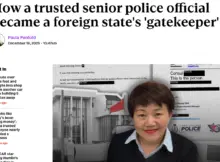
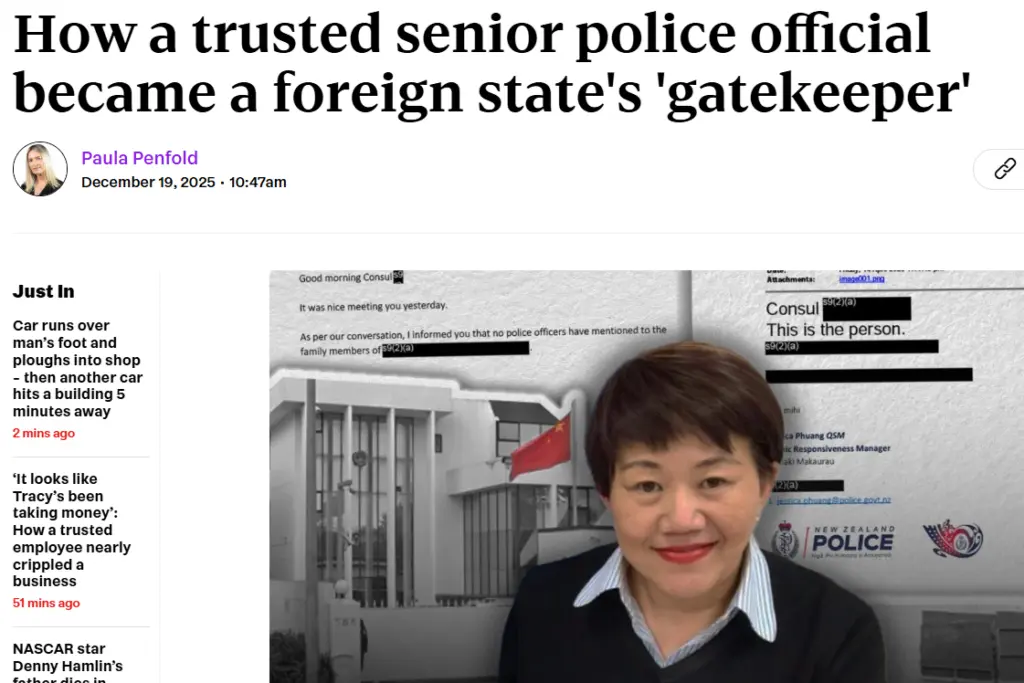
当时担任警方反恐调查经理的侦缉总督察基思·博雷尔(Detective Inspector Keith Borrell),将相关材料转发给警方国家安全主管、侦缉总警司肖恩·汉森(Detective Superintendent Sean Hansen),并请求就此事进行讨论。但警方文件未显示国家安全组是否采取了任何行动。
约在同一时期,警方反恐调查经理博雷尔还将Jessica Phuang 同中国领事官员的相关邮件发给时任警方廉政与行为(integrity and conduct)负责人的总警司贾森·加思里(Superintendent Jason Guthrie)。