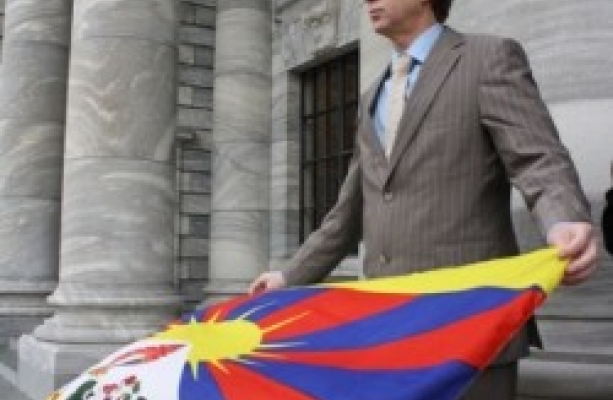
Green Party co-leader Russel Norman should be congratulated on successfully winning the game of name recognition.
When Dr Norman dangled the Tibetan flag in front of the visiting Chinese Vice-President Xi Jinping, repeating the words “freedom for Tibet, freedom for the people of Tibet”, wide debate instantly raged within the Chinese community in New Zealand.
Chinese community leaders demanded an apology from the Greens co-leader. Jerry Yang, editor-in-chief of Auckland-based United Chinese Press (published in both Chinese and English) said Dr Norman should apologise for abusing his position as an MP and stretching the boundaries of freedom of expression.
Based on the take of the opinion leaders there are two approaches to help us understand the relevant issues – a selfish approach and conversely, an open approach.
For some, they care more about the living standard and well-being of ordinary New Zealanders than the Dalai Lama, who lives thousands of miles away on the other side of the world. In that regard, how much damage has been done to our relationship with China, our second largest trading partner, due to Dr Norman’s actions remains to be assessed.
For the others, the real essence of human rights and freedom of speech should be argued.
In that vein, when National MP and Minister for Ethnic Affairs Hon Pansy Wong expressed her view in the Chinese media that Dr Norman’s actions were disgraceful, it struck a chord among the Kiwi-Chinese community.
“Freedom for Tibet, freedom for the people of Tibet”.
To understand this politically-laden slogan, there are at least three intrinsic issues that need to be evaluated.
Firstly, does Dr Norman mean free Tibet from the People’s Republic of China?
China established what is now known as Tibetan Autonomous Region in the early 1950s, which put an end to the notoriously cruel system of serfdom on Tibet.
There are two versions of the Dalai Lama. For those of his followers his Holiness is a saint. For others, he is viewed as the leader who supported a system of slavery in Tibet which the Chinese authorities put an end to in the 1950s.
What Westerners do not know, or do not want to know, as argued by the other party, is what level of cruelty the Theocratic Serfdom under Dalai Lama had to offer. An exhibition in New Lynn in 2009 displayed:
• Tibetan Lamaism instruments for worship ceremony made by human parts including human skin drum and a necklace made of finger bones,
• A “gandong” (a flute made of human leg bone)
• Skin from serfs (including children) for religious purpose
• Serf’s eyes gouged out for punishment
Or when Dr Norman says ‘Free Tibet’, does he mean to say free Tibet from the Dalai Lama? The Dalai Lama was both a religious and political leader that ruled the region with great influence over its entire people – is this who the Tibetan people need freeing from?
Thirdly and closely related to the second part, free Tibet from which Dalai Lama? The Dalai Lama Dr Norman so cared about is “His Holiness the 14th Dalai Lama” which means, literally, there were 13 such chief monks before the current one who all as leaders of both politics and religion were grand owners of serfs.
In fact according to statistics in the early years of the 17th century Qing Dynasty the serf owners, nobles and the upper-temple monks made up of less than 5% of the population but occupied and owned all Tibet’s farmland, pastures, forests, mountains, livestock and rivers as well as the serfs.
Wikipedia explains the origin of the title of Dalai Lama as such:
“in 1578 the Mongol ruler Alan Khan bestowed the title Dalai Lama on Sonam Gyatso. The title was later applied retrospectively to the two predecessors on his reincarnation line, Gendun Drup and Gendun Gyatso. Gendun Gyatso was also Sonam Gyato’s predecessor as abbot of Drepung monastery…”
And the relationship between Tibetans and the Han Chinese dated back as early as the Tang dynasty from the 7th to the 10th century A.D.
We don’t know how accurate the history is but the history is complicated enough for us to appreciate that the Tibetan issue is not as simple as what Dr Norman tried to chant.
The problem Dr Norman has – as argued by the Chinese community here in New Zealand – is that he wanted to teach the visiting Chinese leader a lesson but without understanding the history of the region.
Dr Norman may believe that his supporters don’t care about history. It is true that for too long many Kiwis were exposed to only one side of the story.
And sometimes it is painful to see that some of Dr Norman’s supporters have just enjoyed sticking to the one sided story and could not be bothered to look at the other side. Indeed it is sometimes difficult to even initiate a quality debate on sensitive issues such as that of Tibet.
Prejudice originated from ignorance and ignorance often enhances prejudice. In that vein Dr Norman’s action has made freedom of speech an oxymoron.
If New Zealand as a country is an open court, in the name of justice or for the sake of Buddhism – a religion Dalai Lama represents – at least we can agree that it is warranted that we hear what the other party or parties have to say on this issue.
Human rights and freedom of speech are about truth and should not be calculated for instant media exposure.
If I were a Tibetan I would long for the old ‘notoriously cruel system of serfdom’ than being a minority in my own country with absolutely no say in the current Chinese notoriously cruel system.
In an area fraught (sp) with difficulty in terms of seperating propaganda or interest from “truth” I am still struggling to see exactly what Raymond’s point is? Thanks Raymond for addressing somany and yes, I agree that this is one thing we can thank Labour for, a forum where adults can carry out adult discussions.
“Very interesting, but isn’t it great that you can write this post in a public and one of your colleagues respond with differing points of views” Well said Rebecca
Raymond, why is Tibet so important to China? Is it the military bases nearby? Is it something else? If they have “saved” Tibetans from the cruelty of their former oppressors, why do they now rule them at gun point and in fear od free speech?
I have no idea of the full truth in this situation, but Ihave grave doubts that the full truth will ever come directly or indirectly from the Chinese Government.
I might just ask the Dalai Lama, if I ever meet him again, but you know Raymond, I can’t ask the Chinese P or VP because he has to protected from that kind of question!
李佳懿 (英文名Kiko )1991年10月14日出生在中国湖北,她是2009年2月来新西兰学习的。据TVNZ报道,Kiko先是在Western Springs College学习,她当时想成为一名幼儿园教师。但去年7月,她从该校转走,进入位于奥克兰市中心女王大街155号15楼的一所私立学校St George Institute of Learning 学习商科,而她的人生计划变成开卡拉OK歌厅和桌球室。
根据教育部规定,新西兰招收国际学生的学校都必须遵守政府制定的《对留学生的指导与照顾之行业准则》(Code of Practice for the Pastoral Care)。教育部已要求St George 和Western Springs College两所学校就对这一行业准则的遵守情况写出书面报告。