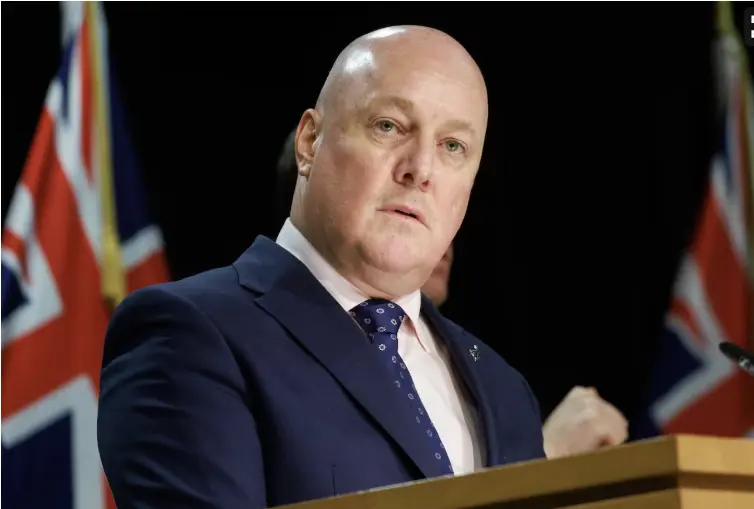
奥克兰 BP New Lynn 加油站的 Ultimate 98 号汽油价格略高于每升 4 新西兰元。(图片来源:NZMEBP)
–
Z Energy 已在其网站和应用程序上发布更新,称 Sharetank 充值服务目前暂停。
Sharetank 允许 Z Energy 用户以更低的价格预购汽油或柴油,并以电子方式存储,直到需要加油为止。无论加油站的油价如何,都可以随时使用 Sharetank 充值,并且最多可以与五位其他 Z Energy 用户共享。司机每次最多可以购买 1000 升汽油,只需在 30 公里范围内找到最优惠的价格即可。
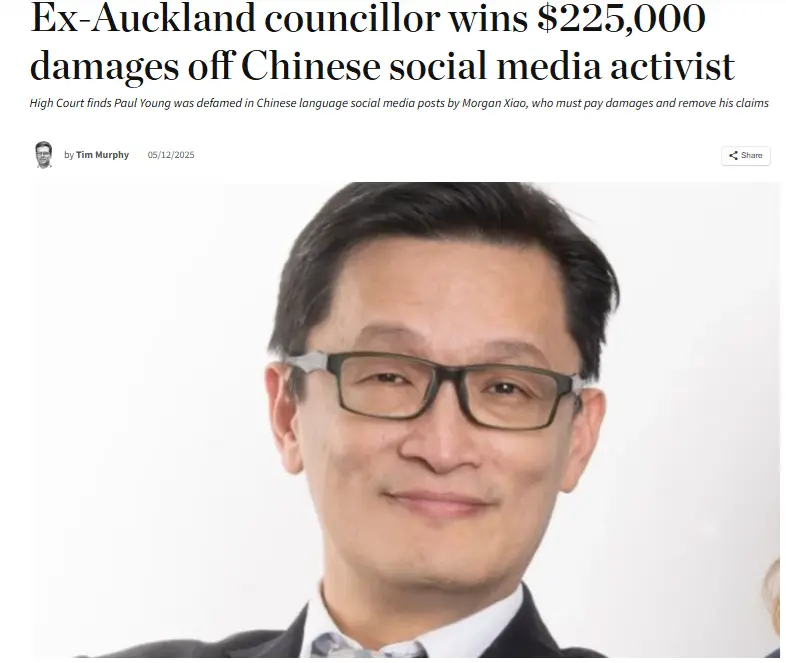
2025年12月1日周一,奥克兰高等法院对当事人通告了对Paul Young 控告魔王肖志鸿诽谤案的裁决。12月5日周五,裁决书公开。当日,新西兰知名媒体人、新西兰英文媒体Newsroom 联合编辑 Tim Murphy 发布文章报道此案。以下是对这篇文章的翻译。
–
前奥克兰市议员 Paul Young 在一宗诽谤案中胜诉,被告是活跃在社交媒体的声名狼藉的肖志鸿(魔王/Morgan Xiao)。案件涉及其在中国社交平台微信上发布的多篇帖子,这些帖子被指控暗示 Young 不适合担任公职,并受到外国势力影响。
奥克兰高等法院(High Court of New Zealand) 法官 Tracey Walker 裁定,肖魔王必须就 2021年至2023年间发布的16篇帖子中的13篇 向Paul Young 支付 22.5万纽元的赔偿金,其中包括一般性赔偿金和加重损害赔偿金(general and aggravated damages)。
Tracey Walker) 法官将这些帖子形容为“一场诋毁运动,完全没有任何负责任传播的特征。”
法官同时驳回了被告肖志鸿提出的抗辩理由,包括:
言论属实(truth)
出于公共利益的负责任传播(responsible communication)
法官指出:“被告在每一项言论中所体现出的责任程度都明显极低。”
法院下令删除帖子并禁止重复相关指控
除支付赔偿外,法官还下令肖魔王:
删除相关帖子
不得重复相关指控
判决书写道:“命令肖不得再发表关于 Young 不忠诚、不诚实、不适合担任公职、腐败、受外国势力影响,以及滥用法院程序(misuse of court proceedings imputations)等指控。”
–
–
Young 曾是奥克兰市议会 Howick 选区的市议员,任期至2022年。今年(2025)10月他曾尝试连任但未成功。
他说,这项判决证明了他三年来的诉讼努力是正确的。
他说:“我希望这一结果能传达一个明确的信息:新西兰的法律体系能够为那些在持续网络攻击中声誉受损的人提供有效补救措施(New Zealand’s legal system provides effective remedies for those whose reputations are attacked through sustained online campaigns)。”
“支持台独”指控成为案件关键
Justice Walker法官指出,案件的核心争议之一是魔王肖志鸿的帖子将 Young 描绘为台湾独立支持者。
判决写道:“这是一个在华人社区中具有高度政治敏感性的议题。”
不过法官指出,肖志鸿的言论还进一步对Paul Young做出下述指控:
不值得信任
腐败
不诚实
不忠诚
Young 否认自己支持台湾独立。他的律师告诉法庭,这样的指控在华人社区“可能对一个人的声誉造成致命打击。”
判决书还提到,在审判结束后,Paul Young 试图把 2025年5月的一篇新帖子添加到其诉讼中。
法官认为该帖子似乎只是重复之前的言论。其中一项争议涉及帖子中的一个图示是否具有某种“文化含义”,暗示 Young 已经“不可救药”。
法官表示:在没有独立专家证据说明这种文化象征意义的情况下,她不会接受这一说法。
这些被认定为诽谤的言论主要以中文发布在微信平台上。微信是全球华人社区广泛使用的社交媒体平台。
Paul Young 认为,魔王肖志鸿的这些帖子旨在破坏他在地方选举中的胜算机会,同时提升肖魔王自己的政治前途。
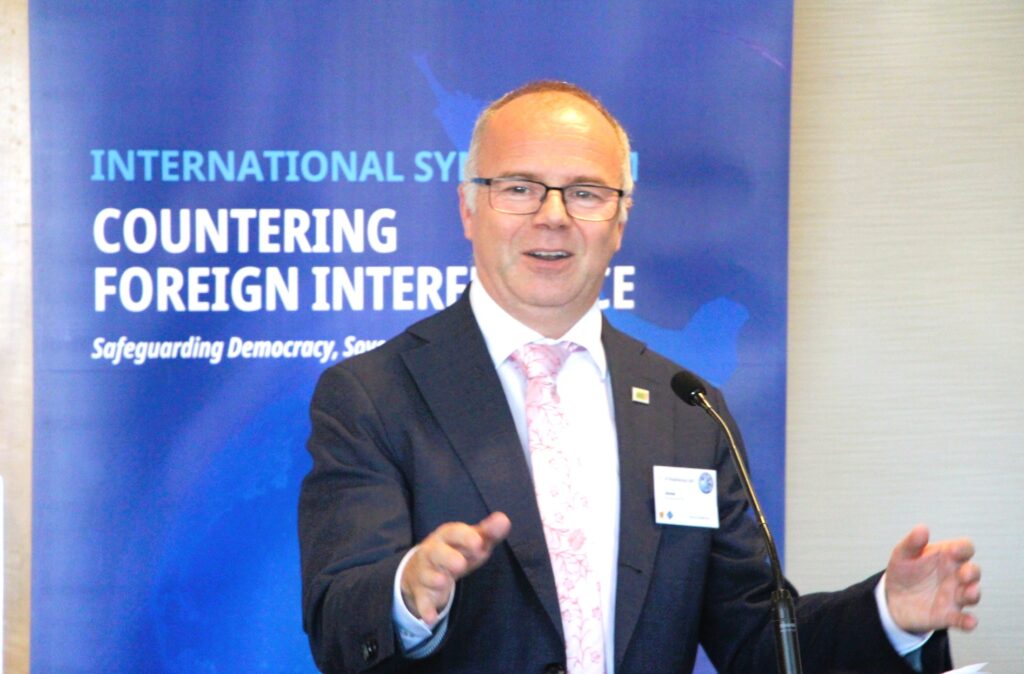
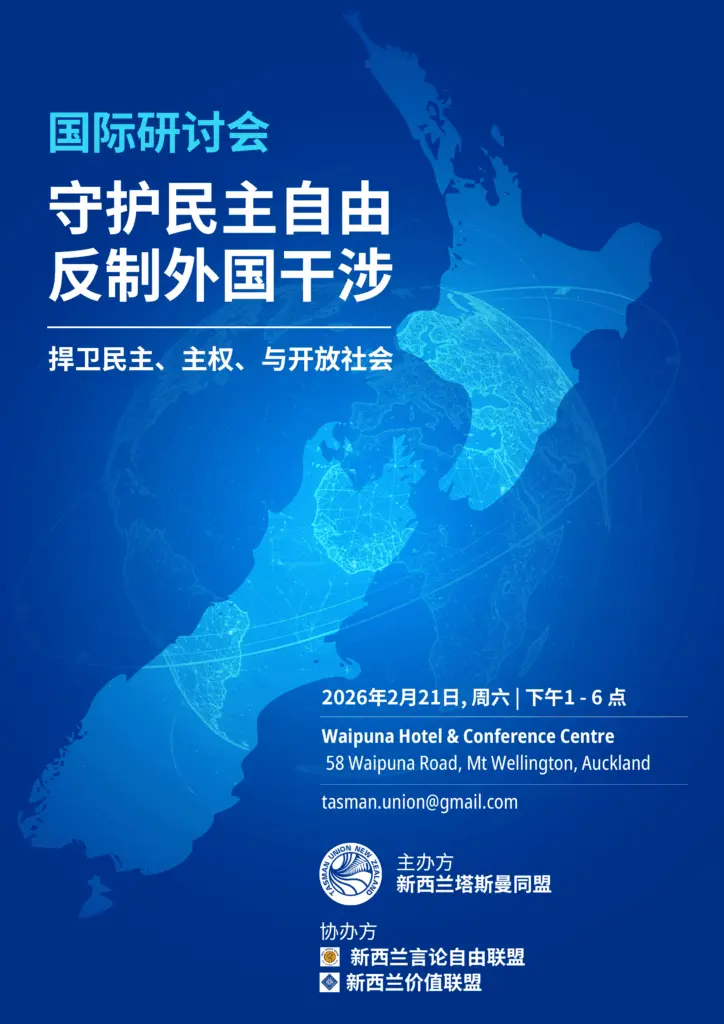
Key notspeech at the Countering Foreign Interference & Safeguarding Democracy, Sovereignty and Open Societies Symposium – 21 February 2026, Auckland
Good afternoon, everyone.
I’d like to extend a warm and heartfelt welcome to this international symposium focused on Countering Foreign Interference and Safeguarding Democracy, Sovereignty & Open Societies.
My name is Jillaine Heather. I am the Chief Executive of the Free Speech Union New Zealand, and the Free Speech Union is proud and honoured to be co- hosting alongside the Tasman Alliance of New Zealand.
I’d like to acknowledge the Tasman Alliance and “Lao Chen “/ Chen Weijian for organising this conference. It takes courage to build a pro-democracy organisation in any country. It takes particular courage when the regime you are standing up to has a very long reach.
I’d also like to welcome and thank all the speakers who have come from across New Zealand and overseas, and extend a warm welcome to our distinguished guests and speakers from Taiwan, and finally to extend a welcome and thank you to everyone here for showing up today to listen and participate.
Look around this room. You are not alone. Every person here has made a choice to be present, to stand up, to refuse to be silent. That is not a small thing. And the fact that we are here together, from different countries, different communities, different experiences, matters. Because the forces that want to silence us count on us feeling isolated, scared and divided. Today is proof that we are not.
Today you will hear from academics, politicians, journalists, experts, and fellow civil liberty advocates – who have all stood up for democratic freedoms.
But I am not here today as an academic or a policy expert. I am here because Portia Mao reached out to the Free Speech Union a few years ago – and her case is a powerful reminder of why freedom of speech – the ability to criticize, ask questions and disagree – is so important in a functioning democracy – and her case demonstrates how quickly that foundation can be attacked.
WHY FREE SPEECH IS THE FIRST TARGET
Foreign interference does not begin with spies or cyberattacks. It begins with silence.It begins with making speech expensive, risky, and exhausting – until people decide it is easier to say nothing.
Every authoritarian regime in history has understood this. The first thing they go after is not the army, the economy or the courts. It is the right to speak, it is communication. Because if you control what people can say, and the information they have access to, you don’t need to control much else.
That is why free speech is not just one freedom among many. It is the freedom that makes all the others possible.
Without it, you cannot organise.
You cannot protest.
You cannot hold power to account.
You cannot even name what is happening to you.
Every other right – democracy, rule of law, freedom of association – depends on the ability to speak.
Two weeks ago, two investigative journalists in China published an article on WeChat exposing local corruption. Three days later, both were arrested. The charge? “making false accusations” – essentially for writing a news article.
Then the article is deleted. Posts supporting the journalists were removed. And the message is clear: speak, and bear the personal cost. Only silence is tolerated
That is China in 2026. But as everyone in this room knows – some of those tactics are here as well.
PORTIA MAO’S STORY
Many of you know Portia Mao. She emigrated from China over two decades ago, became a journalist, and worked with the Stuff Circuit team on the documentary The Long Game, which exposed CCP interference in New Zealand. By putting her name in those credits, she put a target on her back.
Now what happened next should alarm every person in this room. A man she had investigated – Morgan Xiao, an aspiring politician and ardent CCP supporter – used the Harmful Digital Communications Act to obtain a court order barring Portia from criticising him. The application and court order was made without her knowledge.
The court sent one email – it bounced. Nobody tried again. Portia found out because Xiao was bragging about his victory on a Chinese-language chat forum.
Let me say that again. A journalist in New Zealand was gagged by a court order she never knew about, obtained by a man using a New Zealand law to silence scrutiny of his political activities.
Honestly, you could not make this up.
WHAT THE FSU DID
So, Portia reached out to the Free Speech Union for help. The FSU funded a barrister (her lawyer) to represent her.
In June last year, the judge ruled in Portia’s favour. He found her commentary did not amount to harmful digital communications. He found Morgan Xiao was – and I am quoting the court – “not a vulnerable person.” He warned against the weaponisation of legal tools to silence political criticism.
But Xiao was not finished. He tried the same thing against Justin Wong, a journalist for Stuff. Justin’s crime?
He had reposted one of Portia’s articles on LinkedIn.
He had also sent Xiao an email asking questions for a story.
The judge dismissed this case, and in her decision, she cited Portia’s case – the precedent the Free Speech Union helped set. The earlier victory directly protected the next journalist.
That is how this works. You fight for one person’s right to speak, and you slowly but surely build a wall that protects everyone who comes after.
And that is why gathering like this matters. Every case we win, every person who stands up, every room like this one – it makes the next act of courage, or defiance a little less lonely and a little less costly.
THE PATTERN
Now, these cases are part of a pattern – and many of you know it far better than I. Within the Chinese community in New Zealand, people who criticise the CCP get labelled “anti-China.” They are abused on Chinese-language social media.Their families back in China are contacted. They are surveilled. They are photographed at events like this one.
I want to be very clear: this should not be happening in New Zealand. New Zealand is not part of China. The political standards of the Chinese Communist Party have no authority here. Every person in this country has the right to criticise any government, any party, and any leader.
That is not a privilege. It is the baseline of a functioning democracy.
The NZ Security Intelligence Service’s 2025 threat report named the People’s Republic of China as the most active state conducting foreign interference in New Zealand. The Director-General said the public would often notice threats before the intelligence services did. – He was talking about you.
And it is not just Chinese born individuals. Three weeks ago, the Chinese Embassy in Wellington publicly condemned the New Zealand Herald for publishing an opinion piece about Taiwan – written by Jonathan Ayling.
A foreign embassy – telling a New Zealand newspaper what it is and is not allowed to print. We issued a media release emphasizing that our media exists to serve a New Zealand audience, not to reflect the sensitivities of overseas states.
WHY THE FSU MATTERS – WHO WE ARE
I want to speak directly about why the Free Speech Union’s work matters so deeply – particularly for diaspora and minority communities.
Portia’s case was not just about one journalist. It was about whether the Chinese community in New Zealand would be allowed to have independent voices, an independent press, and independent thought.
The outcome of the judge’s ruling matters beyond the courtroom. It helps shape how members of the community understand and choose between different values.
It says: in New Zealand, you are free to speak and free to criticise. And if someone tries to silence you, there are people who will stand with you.
Free speech is not a luxury for the comfortable majority nor just a privilege of the powerful (as we so often hear these days). It is the enabling right – the foundational right that makes all other rights usable. And the people who need it most are often the minority cowant to speak directly about why the Free Speech Union’s work matters so deeply – particularly for diaspora and minority communities.
Portia’s case was not just about one journalist. It was about whether the Chinese community in New Zealand would be allowed to have independent voices, an independent press, and independent thought.
The outcome of the judge’s ruling matters beyond the courtroom. It helps shape how members of the community understand and choose between different values.
It says: in New Zealand, you are free to speak and free to criticise. And if someone tries to silence you, there are people who will stand with you.
Free speech is not a luxury for the comfortable majority nor just a privilege of the powerful (as we so often hear these days). It is the enabling right – the foundational right that makes all other rights usable. And the people who need it most are often the minority communities with the least institutional support.
For those who do not know us – the Free Speech Union exists to defend the right to speak, to think, and to question, freedom of speech, conscience and intellectual inquiry
mmunities with the least institutional support.
For those who do not know us – the Free Speech Union exists to defend the right to speak, to think, and to question, freedom of speech, conscience and intellectual inquiry
We are a registered trade union, which means that we can represent members in workplace freedom of speech disputes.
We are non-partisan. We don’t care where you sit politically.
We care whether you can speak.
We have written over 120 letters to ministers, regulators, and institutions. We have filed more than 100 submissions. We have supported people who have lost their jobs, faced disciplinary action, or been dragged through the courts for saying what they believe. And it has worked.
We funded Portia’s legal defence and won, setting a precedent that protected the next journalist targeted by the same complainant.
We backed a 15-year-old student excluded from his school speech finals for the content of his speech, and the school apologised and invited us in to deliver free speech training.
We exposed unlawful police training that treated ordinary opinions as hate incidents
We fought hate speech laws and won.
We advocated for academic freedom legislation, and the Select Committee adopted most of our recommendations.
These are not abstract wins,
They are people who kept their voices, their jobs, and their dignity.
If you are facing pressure for speaking out – legal threats, workplace consequences, community intimidation – contact us. Become a member, we are a grass roots donor funded organization, support us, refer cases to us.
Every case we are able to take on makes the next person’s voice a little easier.
CHANGING THE LAW
And the good news is that the legal landscape is shifting – and the FSU has been part of making that happen.
The Harmful Digital Communications Act was meant to protect vulnerable people from online bullying. Portia’s case proved it can be weaponised to silence political speech.
In December, Melissa Lee, a Member of Parliament, lodged an amendment bill, developed in close consultation with the FSU, to fix exactly that:
stronger protection for political commentary,
a public interest defence, and
no more gagging people who do not even know they are in court.
And in November last year, Parliament passed the Crimes (Countering Foreign Interference) Amendment Act, creating new offences for covert, deceptive, or coercive actions on behalf of a foreign state. You will hear more about this from the speakers directly involved.
These changes signal something important: New Zealand is beginning to take foreign interference seriously, not just as an intelligence problem, but as a threat to democracy (whicThese changes signal something important: New Zealand is beginning to take foreign interference seriously, not just as an intelligence problem, but as a threat to democracy (which is fragile and needs protection), and as a threat to the rights of people in communities like yours.h is fragile and needs protection), and as a threat to the rights of people in communities like yours.
REMOVING THE FEAR
I want to close with something simple. This conference exists because people refused to be silent.
Portia published her journalism because the public had a right to know. She was gagged. She fought back. She won. She is still here.
Justin Wong asked questions for a story. He was taken to court. The case was thrown out. He is still reporting.
Every person in this room who has chosen to speak – despite the risk, despite the cost, despite the pressure – is doing something profoundly important.
Because free speech does not survive on its own. It survives because people insist on using it.
Foreign interference depends on silence. It depends on fear. Every time someone in this room speaks, that silence cracks a little more.
And every time we gather like this – across borders, across communities, across languages – we prove something the authoritarians do not want proved: that the people who believe in freedom outnumber the people who fear it.
You are not alone in this fight. The person sitting next to you is not alone. And neither are we.
Free speech is not given to us by governments. Free speech is the natural condition of a free people. It is what happens when fear is removed.
Our job – the Free Speech Union’s job, your job, all of our jobs – are to speak up individually and collectively to remove the fear.
2月20日,美国最高法院就Learning Resources, Inc. v. Trump 和Trump v. V.O.S. Selections, Inc.案件做出判决。这两起上诉案均涉及特朗普总统依据《国际紧急经济权力法》(IEEPA)对外国征收的关税。最高法院以6比3的裁决推翻了IEEPA关税。
虽然IEEPA关税被宣布无效,但这并不意味着特朗普向他国加征的关税必然会被退回、取消或者降低。首先,最高法院的判决并未涉及IEEPA关税该如何被退还给进口商。特朗普政府是否退还或者如何退还,最高法院采取了回避的处理方法。与此相关的案件很可能会由下级法院或美国国际贸易法院(Court of International Trade)受理。
其次,这次判决不能阻止特朗普总统使用其他途径或美国现有的其他法律对他国加征关税。特朗普自己也明确表明将加征其他的“合法关税”(legal tariffs)。除了IEEPA 之外,特朗普还可援引的法律为:《1930年关税法》(Hawley-Smoot Tariff Act of 1930)第338条款(简称338条)、《1962年贸易扩展法》(The Trade Expansion Act of 1962)第232条款(简称232条)以及《1974 年贸易法》第301条款(简称301条)和122条款(简称122条)。
《1974年贸易法》301条款则主要针对外国的不公平贸易行为。其宗旨是使总统能对外国的进口限制、出口补贴、低价竞争等其他不公平贸易行为或政策采取迅速的反应和措施。与232调查类似,301调查也需要调查。调查由美国贸易代表办公室(United States Trade Representative)在12个月内完成。
曾任美国副贸易代表的John K. Veroneau 的研究表明,自1949年艾奇逊电报发出以来,还未发现任何与338条相关的公开记录。美国关税委员会1942-1943年的报告指出,由于战时贸易管制,第338条的使用受到限制。随后的年度报告讨论了委员会根据《1930年关税法》其他条款采取的行动,但再未提及第338条。
Democratic Resilience and the Importance of Freedom
Speech to the International Symposium on Safeguarding Democracy and Freedom, and Countering Foreign Interference.
Todd Stephenson
Ladies and gentlemen, distinguished guests, fellow speakers, and friends of freedom.
Thank you once again to the Tasman Union for hosting this important symposium and bringing everyone together today.
For those of you who don’t know me – and I’m sure that’s quite a few – I’m Todd Stephenson, a first-term ACT New Zealand Member of Parliament. While I don’t feel as qualified as many of the other speakers you’ve heard today, I’m very happy to add my voice to this important discussion.
I’d like to acknowledge my fellow Parliamentary colleague, Helen White. Helen and I will ensure our colleagues know about this event and what was discussed. That will include New Zealand’s Deputy Prime Minister, Hon David Seymour, whom I’ll be with this evening.
The Deputy Prime Minister is a strong supporter of Taiwan, and four of the current ACT MPs have visited that beautiful island.
I live in Queenstown. It’s a lovely place to call home. I was born and raised in Southland and attended university in Dunedin. I grew up in the 1980s and 1990s – a time when New Zealand was going through a great deal of economic liberalisation and social reform.
Over this period, our economy was opened up and government intervention reduced. We gained more economic freedoms in what we could produce and buy, and in how we conducted business.
Importantly, we further opened to the world as a trading nation – removing import licences, slashing tariffs, and eliminating subsidies. There were labour market reforms, asset sales, and other changes to the structure of the state.
There were also important social reforms: homosexual law reform, changes to the jurisdiction of the Waitangi Tribunal, New Zealand’s anti-nuclear policy, and – key to the establishment of ACT – the adoption of the Mixed Member Proportional voting system.
We can, of course, have different views on these changes. That is not the point. The point for me is that, growing up, I witnessed first-hand how New Zealanders could exercise their democratic right to vote for change. I came to appreciate for myself just how important democracy is.
Sadly, we live in a world today where democratic countries are vastly outnumbered by non-democratic ones. That’s why events like this are so important – to discuss and debate how we safeguard democracy and its accompanying values.
While New Zealand is one of the world’s longest continuous democracies, we cannot take that for granted. I am deeply committed to the principles of personal freedom, opportunity, and limited government that define our party and attracted me to politics.
In fact, one of the core principles of ACT as a political party is this: “That it is inherent in the nature of human beings as individuals that they are the owners of their own lives and must be free to act according to their own judgments so long as they accept and respect the like freedom of others.”
That sentence is underpinned by the important rights in a liberal democracy, including:
Freedom of expression and opinion (free speech)
Freedom of association and assembly
The right to vote and participate in government
Freedom from discrimination and equality before the law
The right to a fair trial and due process
Freedom of thought, conscience, and religion
Freedom of the press and access to information
As a Parliamentarian, it is important that I think about these rights – and others – every day. Free speech is one that is particularly important to me.
In a world where authoritarian regimes actively seek to undermine open societies through interference, coercion, and disinformation, the ability to speak freely is not merely a luxury – it is the essential mechanism that enables democracies to detect, debate, and defend against such threats.
Democratic resilience is the capacity of a society to withstand external pressures, internal divisions, and attempts at subversion while preserving its core values. Strong institutions, the rule of law, transparent governance, and alliances with like-minded nations all contribute. But none of these can function effectively without robust protections for freedom of expression.
I’ve faced criticism for hosting speakers others don’t agree with at Parliament. What I recognise is that freedom of speech has ensured, over the years, that minorities have been able to speak and advocate about issues important to them. It is a key right that protects minorities. As a Parliamentarian, I often give others the opportunity to express their views, even if I might not hold the same position.
Freedom of speech is the oxygen of democracy: it allows ideas to compete openly, exposes falsehoods, holds power to account, and fosters innovation and progress. Why does freedom of speech matter so much in countering foreign interference? Authoritarian actors – particularly from regimes like the Chinese Communist Party – rely on silencing dissent to maintain control. They export these tactics: intimidating diaspora communities, pressuring academics and media, spreading disinformation, and seeking to influence institutions through united front operations.
Without freedom of speech, we cannot openly discuss these threats, name them, or mobilise responses. Open debate allows us to expose united front activities, cyber intrusions, economic coercion, and attempts to infiltrate politics, universities, and civil society.
We must also continue to look at our protections within New Zealand. As a member of the Justice Select Committee, I was intimately involved in the review of the Crimes (Countering Foreign Interference) Amendment Act, which passed last year. These changes had been proposed for many years, and it was pleasing to see Parliament finally address them.
Today we also heard from PILLAR about their Foreign Influence Transparency Bill. I’ll certainly be taking this idea back for discussion with my colleagues.
We also need to call out other local curiosities when we see them.
Recently there has been a lot of media coverage about Jimmy Lai’s imprisonment in Hong Kong. New Zealand media, including Radio New Zealand, have carried the story – which you could say reflects badly on the Chinese government. However, I’ve been told that Radio New Zealand’s dedicated Chinese portal has not mentioned the story. Is this deliberate censorship, or are those staff involved in the portal worried about themselves and their families?
I’d suggest Radio New Zealand needs to examine the integrity of its Chinese news service while also ensuring the safety of its staff.
New Zealand has a proud tradition of defending freedoms – from our wartime contributions to our Pacific partnerships. We support a modern defence force focused on alliances, stronger ties with Taiwan, and vigilance against foreign influence. Friends, democratic resilience demands the active defence of the rights we take for granted.
By championing freedom of speech and related human rights, fostering cross-party and international commitments, and rejecting censorship in all its forms, we build societies that authoritarian interference cannot conquer.
Let’s commit to a freer, more resilient future together.
Free Speech: The Foundation That Makes All Other Freedoms Possible.
新西兰主要演讲嘉宾
安妮-玛丽·布雷迪(Anne-Marie Brady)教授 著名中国问题研究专家, 坎特伯雷大学 演讲题目:《民主“法宝”与中共“法宝”战略:对新西兰应对中国统战工作的反思》 The ‘Magic Weapons’ of Democracy and the CCP’s ‘Magic Weapon’ Strategy: Reflecting on New Zealand’s Response to China’s United Front Work.
Nick Hanne 先生: PILLAR NZ(捍卫个人生命、自由与权利)联合创始人 演讲题目:《 一部切实有效的法律: 透明与问责》 A Law Fit For Purpose: Transparency and Accountability
Paula Penfold 女士 Stuff 调查记者 演讲题目:《追踪线索:关于影响力与外国干涉的调查报道》 Following the Threads: Reporting on Influence and Interference
Simon O’Connor 新西兰前国会议员、前外交、国防与贸易委员会主席、对华政策跨国议会联盟(IPAC)校友理事会理事 演讲题目:《信仰自由》 / Free to Believe
Helen White MP 工党 Mt Albert 选区国会议员 演讲题目:《民主面临的威胁——对妇女与儿童的影响》